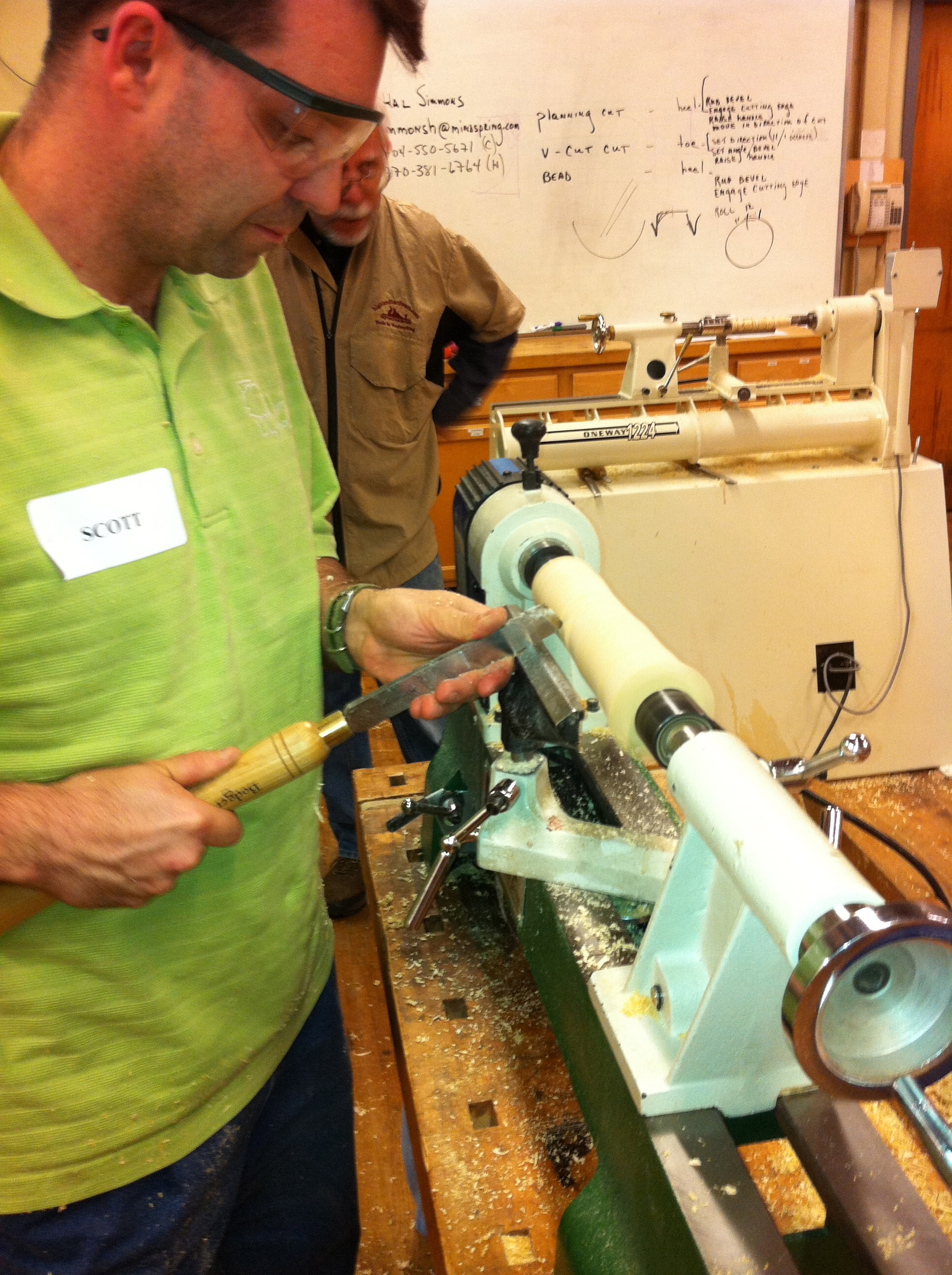
Bet’cha can’t do this. Not many people can cut a perfect arc on a table saw in a thin piece of plywood. Notice how the cut is just the right depth to keep the ply together. Notice how the cut starts in from the side perfectly tangential to the arc. Notice how the cut continues all the way across the workpiece in a perfect arc. Notice the small blood stain in the center of the piece.
Maybe you have guessed by now this is a terrible mistake and a big screwup. I was cutting some pieces of plywood for our annual family gingerbread house construction and I failed to pay sufficient attention near the end of the cut. It got away from me in about one tenth of one second and the next thing I knew it was bouncing off the back wall of the shop about 15 feet behind me. Thank goodness I was wearing a face shield and standing to the side as I always do. The only damage, besides my ego, was a broken fingernail and a pretty good scrape to my ring finger from the flying plywood. That thing took off like a helicopter, flew just past my head, all the way across the room and banged into the wall near the ceiling behind me. It was brutal and scary and reminded me all over again how potentially devastating a moment of carelessness can be in the shop.
I am sure that many of you out there are looking at my saw and noting the lack of a guard and splitter at the blade. You are right and I deserve that. But for all you beginners out there, note this. I am an experienced woodworker who has used a table saw for years and I know how this kind of kickback happens. It happens because I took off the splitter behind the blade and the piece twisted and the back portion of the saw caught the wood and threw it back at me. But you see, I was just going to use the saw for thirty seconds to make a base for a gingerbread house and it was not a real project, and I know all about this stuff cause I write for Highland and I don’t need any advice from you. That kind of thinking is what gets you hurt. Leave the guard on your saw or at the very least, get an aftermarket splitter behind the blade. And be careful out there.
By the way, the way you know you are pretty far gone is when something bad happens, all you can think is “Oh wow, that’s a great blog entry”.
Friday, February 17, 2012
Thursday, January 12, 2012
Woodworking Resolutions for the New Year
Here are some resolutions for this woodworker for the New Year.
1. I will find some good classes to go to. Highland offers a wonderful range of woodworking classes with the added advantage (for me) of no air travel, and no hotel bills since I can come back to my own house every night. In addition, I plan to look into the John Campbell Folk School https://www.folkschool.org/ just over the Georgia line in North Carolina. They offer a wonderful range of classes from a weekend to a full week on a wide variety of subjects from kaleidoscopes to quilting to calligraphy. I kinda like the fly rod stuff. Room and board are included in their fees and you stay in a dorm on site and eat family style in the dining room. To be fair, for lunch Highland points you to the saloon next door where you can eat family style with your class and quite often the instructor too.
2. I will clean the filters in my dust collectors. I looked up at the ambient air cleaner in the ceiling of the shop the other day and it must have a pound of dust in it. The filter is two inches thick and it costs upwards of thirty bucks when you buy a new one. Sure would hate to ruin it.
3. I am moving out all the plywood and pegboard that I have in the shop. I do not like plywood and I do not like things made with plywood. I had some plywood imported from Russia one time and it smelled like a wet dog whenever you cut it. Pegboard is a project killer for me. I am going to stick with real wood and concentrate on “fine” woodworking (whatever that is).
4. I will finish my sculptured rocker, the one on display at Highland. I want to rock in that bad boy and I want the right side to match the left side when I finish it.
5. I want to turn a hollow vessel. It is one of the many gaps in my turning skill set and I just think it is something I need to do well before I can rightfully call myself a woodturner.
6. Add the skew to that. Still working on that boy.
7. I plan on cleaning the shop very well at least one time this year. I will get down on my hands and knees with the shop vac and clean every square foot of the floor. I also think it may be time to throw away all those cut-offs I have been saving for heaven knows what. They tend to build up over the years, especially since I really hate to throw wood away.
8. Clamps are all over the floor. I have no good place to store them and it would be a real joy to have them in one place easily and quickly accessible to a project. I may do a cart or I may try to clean off a wall somewhere and build a wall rack.
9. My son laughs at me all the time for the roll top desk which has been about 85% finished for the last 15 years. Perhaps this is the year. Course he claims it is such a tradition seeing it there unfinished, he would really miss it if it got finished and moved up to the house. Oh yeah, there is a tilt back rolling desk chair which is only partially refinished. And the new mahogany writing table. Oh, and the oak barrister’s bookcase. The second cherry Shaker candle stand. The walnut school house clock. Plus about twenty bowls. Better be a long year.
10. I’m going to fix the work table behind the table saw. Right now, it is about four inches higher than the table saw, so if I want to use it as support when I push a board through the saw, it is too tall. (Really helpful if I ever have another piece of plywood in the shop.) Plus right now it has all those bowls and the clock on top of it in the way. I plan to clean it off, level it up and then mark the legs for cutting to the saw height. Same way you level a chair.
11. And last, I want to learn to make my own custom moldings. I find the subject fascinating, both for the detail involved, the lack of noise and dust, and the universality of the methods used. It appears that virtually any molding can be made entirely by hand and with a few of the right tools, it is achievable by most of we amateurs. Go look at “Big Pink” (don’t ask) on the blog http://musingsfrombigpink.blogspot.com/2011/11/result.html. Course he sells the tools also.
12. Oh yes, I want to learn the bass guitar. I find myself picking out the bass line in any song and in another life if I could choose, I would like to be able to sing bass in a Southern Gospel Quartet. Here’s what I mean: http://www.youtube.com/watch?v=LhAqojyHhc8&feature=related Whenever I find myself playing a little air guitar, it is always the bass line. I’ll never be able to sing it, maybe I can learn to play it.
1. I will find some good classes to go to. Highland offers a wonderful range of woodworking classes with the added advantage (for me) of no air travel, and no hotel bills since I can come back to my own house every night. In addition, I plan to look into the John Campbell Folk School https://www.folkschool.org/ just over the Georgia line in North Carolina. They offer a wonderful range of classes from a weekend to a full week on a wide variety of subjects from kaleidoscopes to quilting to calligraphy. I kinda like the fly rod stuff. Room and board are included in their fees and you stay in a dorm on site and eat family style in the dining room. To be fair, for lunch Highland points you to the saloon next door where you can eat family style with your class and quite often the instructor too.
2. I will clean the filters in my dust collectors. I looked up at the ambient air cleaner in the ceiling of the shop the other day and it must have a pound of dust in it. The filter is two inches thick and it costs upwards of thirty bucks when you buy a new one. Sure would hate to ruin it.
3. I am moving out all the plywood and pegboard that I have in the shop. I do not like plywood and I do not like things made with plywood. I had some plywood imported from Russia one time and it smelled like a wet dog whenever you cut it. Pegboard is a project killer for me. I am going to stick with real wood and concentrate on “fine” woodworking (whatever that is).
4. I will finish my sculptured rocker, the one on display at Highland. I want to rock in that bad boy and I want the right side to match the left side when I finish it.
5. I want to turn a hollow vessel. It is one of the many gaps in my turning skill set and I just think it is something I need to do well before I can rightfully call myself a woodturner.
6. Add the skew to that. Still working on that boy.
7. I plan on cleaning the shop very well at least one time this year. I will get down on my hands and knees with the shop vac and clean every square foot of the floor. I also think it may be time to throw away all those cut-offs I have been saving for heaven knows what. They tend to build up over the years, especially since I really hate to throw wood away.
8. Clamps are all over the floor. I have no good place to store them and it would be a real joy to have them in one place easily and quickly accessible to a project. I may do a cart or I may try to clean off a wall somewhere and build a wall rack.
9. My son laughs at me all the time for the roll top desk which has been about 85% finished for the last 15 years. Perhaps this is the year. Course he claims it is such a tradition seeing it there unfinished, he would really miss it if it got finished and moved up to the house. Oh yeah, there is a tilt back rolling desk chair which is only partially refinished. And the new mahogany writing table. Oh, and the oak barrister’s bookcase. The second cherry Shaker candle stand. The walnut school house clock. Plus about twenty bowls. Better be a long year.
10. I’m going to fix the work table behind the table saw. Right now, it is about four inches higher than the table saw, so if I want to use it as support when I push a board through the saw, it is too tall. (Really helpful if I ever have another piece of plywood in the shop.) Plus right now it has all those bowls and the clock on top of it in the way. I plan to clean it off, level it up and then mark the legs for cutting to the saw height. Same way you level a chair.
11. And last, I want to learn to make my own custom moldings. I find the subject fascinating, both for the detail involved, the lack of noise and dust, and the universality of the methods used. It appears that virtually any molding can be made entirely by hand and with a few of the right tools, it is achievable by most of we amateurs. Go look at “Big Pink” (don’t ask) on the blog http://musingsfrombigpink.blogspot.com/2011/11/result.html. Course he sells the tools also.
12. Oh yes, I want to learn the bass guitar. I find myself picking out the bass line in any song and in another life if I could choose, I would like to be able to sing bass in a Southern Gospel Quartet. Here’s what I mean: http://www.youtube.com/watch?v=LhAqojyHhc8&feature=related Whenever I find myself playing a little air guitar, it is always the bass line. I’ll never be able to sing it, maybe I can learn to play it.
Monday, December 19, 2011
Using Woodworking Skills for Habitat for Humanity
It occurs to me that many of the people who frequent this Blog would be interested in one of my favorite things, i.e. Habitat for Humanity. Not to be bragging, but I am probably up to 75 houses that I have worked on in some fashion or other over the years. A few more and maybe I will learn how to actually build a house. Let me tell you about it.
The system is pretty typical around the country. A corporate sponsor or group or individual comes forward and offers the money needed to purchase the land and the building materials. Then the sponsor or group will collect volunteers (that’s you, Pilgrim) to come and actually do the construction work. In my local Chapter, we look for about 30 to 35 people per day on the site, and we schedule about ten days to complete a 1400 square foot house. The Chapter obtains the land and the building materials, the permits and licenses, and provides essential construction expertise. The skilled trades which require licenses will be hired by the Chapter.
Once everything is in place, construction begins and that is the really fun part. Day One and Day Two are the best. In our Chapter, we are sorely disappointed if all the walls are not standing by the end of the first day. Roof trusses are usually scheduled on Day Two and the rest of the work proceeds from there.
One of the real joys of the construction time is working with the family who will live in the house. A requirement for purchasing (that’s right — purchasing) a Habitat House is the sweat equity investment. Before we will sell the house to a family, they must put in 250 hours (logged in and out) working on either their house or someone else’s Habitat house. Plus they must attend a 50 hour course on financial management as taught by Dave Ramsey of radio fame. Once they have made the hours and completed the course work and shown they can handle the payments, then we sell the house to them for the cost of materials and land. We provide a twenty year mortgage at zero per cent interest. At the end of twenty years, the house belongs to the family with no further obligation to Habitat.
But then, you ask, if the materials are furnished by the sponsor, and the labor is all volunteer, why is there a mortgage? The answer is that we take the money which comes in from the mortgages, pay a minimal staff, and then use the rest as seed money to build more houses. It is somewhat like a benevolent Ponzi scheme. Our Chapter for instance has built about 125 houses so we have around 125 mortgage payments coming in each month. Larger Chapters have built 1500 or more houses.
Habitat works all around the world. In fact, as a salute to our Christian beginnings, we tithe our monetary donations. Turns out you can build a house in Guatemala for about $3000. As a result, Habitat International recently celebrated construction of its 500,000th home. Corporate Donors also step up constantly. For example, Whirlpool Corporation donates a stove and refrigerator to every single house built in America by Habitat. When we finish a house, we call Whirlpool and they send them out. That’s why I buy Whirlpool every chance I get. Blessings on them and hundreds of others who do likewise.
How do you fit into this scheme? Call your local Chapter and see what you can do. Start by showing up on the site one day to offer your labor in construction. Look around and see what they need. What you will find is a bunch of good people doing something they love for the benefit of someone who will never have a home any other way. Match your skills to their needs and it will be a good thing for both of you. Go do some good!!
The system is pretty typical around the country. A corporate sponsor or group or individual comes forward and offers the money needed to purchase the land and the building materials. Then the sponsor or group will collect volunteers (that’s you, Pilgrim) to come and actually do the construction work. In my local Chapter, we look for about 30 to 35 people per day on the site, and we schedule about ten days to complete a 1400 square foot house. The Chapter obtains the land and the building materials, the permits and licenses, and provides essential construction expertise. The skilled trades which require licenses will be hired by the Chapter.
Once everything is in place, construction begins and that is the really fun part. Day One and Day Two are the best. In our Chapter, we are sorely disappointed if all the walls are not standing by the end of the first day. Roof trusses are usually scheduled on Day Two and the rest of the work proceeds from there.
One of the real joys of the construction time is working with the family who will live in the house. A requirement for purchasing (that’s right — purchasing) a Habitat House is the sweat equity investment. Before we will sell the house to a family, they must put in 250 hours (logged in and out) working on either their house or someone else’s Habitat house. Plus they must attend a 50 hour course on financial management as taught by Dave Ramsey of radio fame. Once they have made the hours and completed the course work and shown they can handle the payments, then we sell the house to them for the cost of materials and land. We provide a twenty year mortgage at zero per cent interest. At the end of twenty years, the house belongs to the family with no further obligation to Habitat.
But then, you ask, if the materials are furnished by the sponsor, and the labor is all volunteer, why is there a mortgage? The answer is that we take the money which comes in from the mortgages, pay a minimal staff, and then use the rest as seed money to build more houses. It is somewhat like a benevolent Ponzi scheme. Our Chapter for instance has built about 125 houses so we have around 125 mortgage payments coming in each month. Larger Chapters have built 1500 or more houses.
Habitat works all around the world. In fact, as a salute to our Christian beginnings, we tithe our monetary donations. Turns out you can build a house in Guatemala for about $3000. As a result, Habitat International recently celebrated construction of its 500,000th home. Corporate Donors also step up constantly. For example, Whirlpool Corporation donates a stove and refrigerator to every single house built in America by Habitat. When we finish a house, we call Whirlpool and they send them out. That’s why I buy Whirlpool every chance I get. Blessings on them and hundreds of others who do likewise.
How do you fit into this scheme? Call your local Chapter and see what you can do. Start by showing up on the site one day to offer your labor in construction. Look around and see what they need. What you will find is a bunch of good people doing something they love for the benefit of someone who will never have a home any other way. Match your skills to their needs and it will be a good thing for both of you. Go do some good!!
Christmas Wish List
Christmas is coming and it is time to look at the old wish list. My family laments the fact that I have all the $30 woodworking tools. Anything I still need/want is going to be more. Assuming you have been a good boy or girl, perhaps it will be a fruitful year in the workshop. For the sake of any of you friends and family (particularly my son Jon) who might be looking for something to grace this old blogger, here is my list for this year. Maybe there is something you might like on my list.
1. I would like to be able to write songs like Brian Wilson of the Beach Boys and sing like George Younce of the Cathedrals. Oh wait, did you say this was a Wish List for a Woodworking store? Sorry, those two just slipped out.
2. Hollow Chisel Mortiser — Highland has a top notch power mortiser from Steel City for $299.99. I saw it in the store this week and it is high on my list. If you do a fair amount of mortise and tenon joints, then this tool may be just right for you. It is bench mounted and has a rack and pinion adjustable fence for easy alignment. The handle adjusts to six positions and is reversible. The switch is right up front and easy to reach. The bits lock into the spindle and there should be none of that twisted bits stuff which is so irritating on lesser models. This thing looks like an excellent medium duty machine for the serious amateur mortise maker.
3. ANYTHING from Festool. I have not started my Festool collection yet, but these tools are always on my list. Given my choice, I would start with the chop saw, then the router, and then the sanders with the vac.
When I was working on my rocking chair, Charles Brock in his shop had the heavy duty Festool sander hooked up to the Festool vacuum and it is a sweet operation. Probably not going to happen this year, but perhaps if I am very, very good next year.
4. Sawstop Table Saw — Highland can ship the SawStop Contractor Saw to all the lower 48 states now and if you are looking at a table saw, you owe it to your spouse and family to keep all your fingers. Touted as the safest table saw out there, don’t ask for any other saw without looking seriously at this one. Watch the famous hot dog video, (or the chicken leg demo) and you will be a fan.
5. Fein MultiMaster — I have seen the commercials on TV for this thing. What really convinced me, however, was when the construction manager at my Habitat for Humanity chapter pulled one of these out of his truck. We needed to notch out a board to set a marble counter top, and there was no good way to do the work without tearing half the wall down. We turned this thing on and in about 30 seconds, the job was done. Be careful, though because there are many lower-quality imitators out there, ranging from the $29.95 version at the tool discount store to somewhat more expensive models from some of the major manufacturers. The real thing may seem a little pricey, but it is worth every penny. Also do some research on the blades, because there is a very wide range of quality available in blades and they can be a costly error if you get the wrong ones. The Fein Multimaster model I would like is the FMM 250Q Select Plus kit, which until recently sold for $329, but is available at Highland right now for $299. It should do almost all I need right now, and I can always buy accessories for it as I need them.
6. Auriou Chairmaker’s Rasp Set — If you have never used one of these things and all you have ever tried is one of those five dollar rasps from the local hardware, then you are in for a revelation. I had never used one of these things until I worked on a sculptured chair. Who knew that the single biggest issue with one of these beautiful tools is you have to be careful to not remove too much wood.
How many hand tools do you use where taking off too much wood is the main problem? Most of the time, I have trouble just getting tools to cut in the first place. Well, you say, I sure as heck ain’t paying that much money for a stupid rasp. Well, nay, I say, nay! First of all, these rasps will last the rest of your life and your children will bless you for them. Second, once you try them you will wonder how you missed them your whole woodworking life. Just try one and you will agree with me. (By the way, Jon, I like the set of three for $349.99.)
There you go. Slide this list under the door for somebody, or leave it open on the computer. Or print it out and leave it under the breakfast cereal. If you don’t score any of these things this year, try being gooder next year. I’ll let you know how it worked out for me.
1. I would like to be able to write songs like Brian Wilson of the Beach Boys and sing like George Younce of the Cathedrals. Oh wait, did you say this was a Wish List for a Woodworking store? Sorry, those two just slipped out.
2. Hollow Chisel Mortiser — Highland has a top notch power mortiser from Steel City for $299.99. I saw it in the store this week and it is high on my list. If you do a fair amount of mortise and tenon joints, then this tool may be just right for you. It is bench mounted and has a rack and pinion adjustable fence for easy alignment. The handle adjusts to six positions and is reversible. The switch is right up front and easy to reach. The bits lock into the spindle and there should be none of that twisted bits stuff which is so irritating on lesser models. This thing looks like an excellent medium duty machine for the serious amateur mortise maker.
3. ANYTHING from Festool. I have not started my Festool collection yet, but these tools are always on my list. Given my choice, I would start with the chop saw, then the router, and then the sanders with the vac.
When I was working on my rocking chair, Charles Brock in his shop had the heavy duty Festool sander hooked up to the Festool vacuum and it is a sweet operation. Probably not going to happen this year, but perhaps if I am very, very good next year.
4. Sawstop Table Saw — Highland can ship the SawStop Contractor Saw to all the lower 48 states now and if you are looking at a table saw, you owe it to your spouse and family to keep all your fingers. Touted as the safest table saw out there, don’t ask for any other saw without looking seriously at this one. Watch the famous hot dog video, (or the chicken leg demo) and you will be a fan.
5. Fein MultiMaster — I have seen the commercials on TV for this thing. What really convinced me, however, was when the construction manager at my Habitat for Humanity chapter pulled one of these out of his truck. We needed to notch out a board to set a marble counter top, and there was no good way to do the work without tearing half the wall down. We turned this thing on and in about 30 seconds, the job was done. Be careful, though because there are many lower-quality imitators out there, ranging from the $29.95 version at the tool discount store to somewhat more expensive models from some of the major manufacturers. The real thing may seem a little pricey, but it is worth every penny. Also do some research on the blades, because there is a very wide range of quality available in blades and they can be a costly error if you get the wrong ones. The Fein Multimaster model I would like is the FMM 250Q Select Plus kit, which until recently sold for $329, but is available at Highland right now for $299. It should do almost all I need right now, and I can always buy accessories for it as I need them.
6. Auriou Chairmaker’s Rasp Set — If you have never used one of these things and all you have ever tried is one of those five dollar rasps from the local hardware, then you are in for a revelation. I had never used one of these things until I worked on a sculptured chair. Who knew that the single biggest issue with one of these beautiful tools is you have to be careful to not remove too much wood.
How many hand tools do you use where taking off too much wood is the main problem? Most of the time, I have trouble just getting tools to cut in the first place. Well, you say, I sure as heck ain’t paying that much money for a stupid rasp. Well, nay, I say, nay! First of all, these rasps will last the rest of your life and your children will bless you for them. Second, once you try them you will wonder how you missed them your whole woodworking life. Just try one and you will agree with me. (By the way, Jon, I like the set of three for $349.99.)
There you go. Slide this list under the door for somebody, or leave it open on the computer. Or print it out and leave it under the breakfast cereal. If you don’t score any of these things this year, try being gooder next year. I’ll let you know how it worked out for me.
Thursday, October 20, 2011
The Fullsized Finisher
Did you ever notice how we have these woodworking cliches? We never “grab a chisel”, we always “grab a sharp chisel”. Let me think about that for a second. I want to make a fine paring cut on a piece of hard maple, so I think I will get my dull chisel. In my profession, the Attorney General of the State of Georgia got involved one time in a legal opinion about Land Surveyors. Question was whether we had to call ourselves “Registered Land Surveyors” or simply “Land Surveyors”. His legal opinion was that if you were not registered then you were not a land surveyor. There are only “Land Surveyors”, and any label past that was superfluous. I agree — no more “sharp” chisels, only “chisels”.
Same thing happens in woodturning — we never have a catch, we always have a “nasty” catch. I agree that catches are always nasty, and I still hate them. They scare me pretty good most of the time.
I was practicing last week with the next tool in the Easy Wood Tool group, the Full Finisher. Watch the video below and you can see how it works. It really is a smooth cut and you can get quite aggressive with it. The piece was wet, ash I think, and I had roughed it out a few days before and then put it back on the lathe to round it off and thin it out.
What I think a lot of woodturners miss is listening to the sound of the tool cutting. You can tell a lot by the sound the tool makes as it cuts. After a while, the tool makes a steady droning sound and you can tell when you get some wobble in the shape and the tool is not following very well. You get a little bit of that high pitched wail from movies set in the Middle East where the men are going off to war and the women are cheering them from the top of the cliffs. Listen to the sound I left in the video and you will see what I mean.
I went to a class with a bunch of beginners one time and the sounds in the room drove me up the wall. Even at that early stage of my turning career, I could hear the pieces beginning to break apart, but the people doing the work had no idea what was about to happen. Now and then one would explode and fly all over the room, but somehow that was easier to take than waiting for one to bust once I heard that sound.
I think I overstepped the capability of the Easy Finisher with the size of the bowl I was using it on. Probably overstepped my capability also. I went back to the Easy Tools web site and watched their demonstration again, and they were working on a smaller bowl. I think that may be the key. That and a lot more practice.
It is hard for me to watch the video cause I know what’s coming. Maybe we should call all catches nasty. Least I didn’t cuss, I just hollered. Or screamed like a little girl, whichever you think. Let’s see what you say if it happens to you.
Tuesday, May 24, 2011
Tool Kit
The CDC issued guidelines to follow in case of a Zombie Apocalypse. (You may think I am making this up, so here is the actual real link). This warning really hit home with me since my shop is in the back yard in the deep woods so to speak, and it can get really spooky (not to mix metaphors) out there at night. After dark with the lights on in the shop, you cannot see what is going on outside, and when you get absorbed in a delicate little dovetail joint, the whole world could end around you and you would hardly know it until it was too late to do anything about it (as if you could). I have often wondered what steps I would need to take in case zombies (the technical term for the condition is Ataxic Neurodegenerative Satiety Deficiency Syndrome) showed up at the shop. For instance, the CDC recommends that you set up a meeting place outside the home so your family can rendezvous and escape together to a zombie-free refugee camp. They post a list of supplies to take with you including water and food and a first aid kit, though they do admit that once bitten the first aid kit will not be of much use.
The thing they are missing though, is defensive tools to protect yourself from a zombie attack. I think woodworkers are particularly well-equipped to protect themselves with things both portable and effective already in nearly every woodworking shop. My lathe skew chisel (properly sharpened) with its slanted blade and sharp point would be very effective in zombie defense. My battery powered drill (I will need to keep the batteries charged better than I normally do) with a two inch spade bit would be helpful. Oh wait, how about the drill mounted three inch hole saw -- I think that would be better. The battery powered reciprocating saw is an awesome tool, effective in many situations where no other tool will work. If you have ever caught your finger in one of those Japanese cut-off saws, you will recognize what damage that thing could do when properly applied to larger fleshy appendages. And as in most woodworking operations, having this saw cutting on the pull stroke makes it much easier to use when you are in a rush to finish a project. Last but not least, is my chain saw. I prefer a 20 inch blade to give me a little more depth of cut, and you don’t need a really big saw -- too heavy to lift to shoulder height on a continuing basis. Just make sure it has the proper gas and oil mix so you can get it started easily. When you need it, you need it quick.
I am going to recommend to the store that we put together a Highland Zombie Apocalypse Preparedness Kit. It should include all the materials recommended by the CDC, plus the things I have suggested. I think we will put it in a big tool bag so you can grab it and go on short notice. The problem with that is you will not be able to use the tools from the Kit without taking a chance on missing some of them when you have to leave in a rush. Just use them and put them back in the Kit when you are done. We are open to suggestions here people. Send us your ideas and perhaps you will see them incorporated into our Kit. Now go fuel up the chain saw. Be prepared!! Stay safe. Keep your brain.
Monday, April 11, 2011
Skew Class: Conquering my Fears
I hesitate to say I have tamed the skew, but at least I can live in the same house with it now.
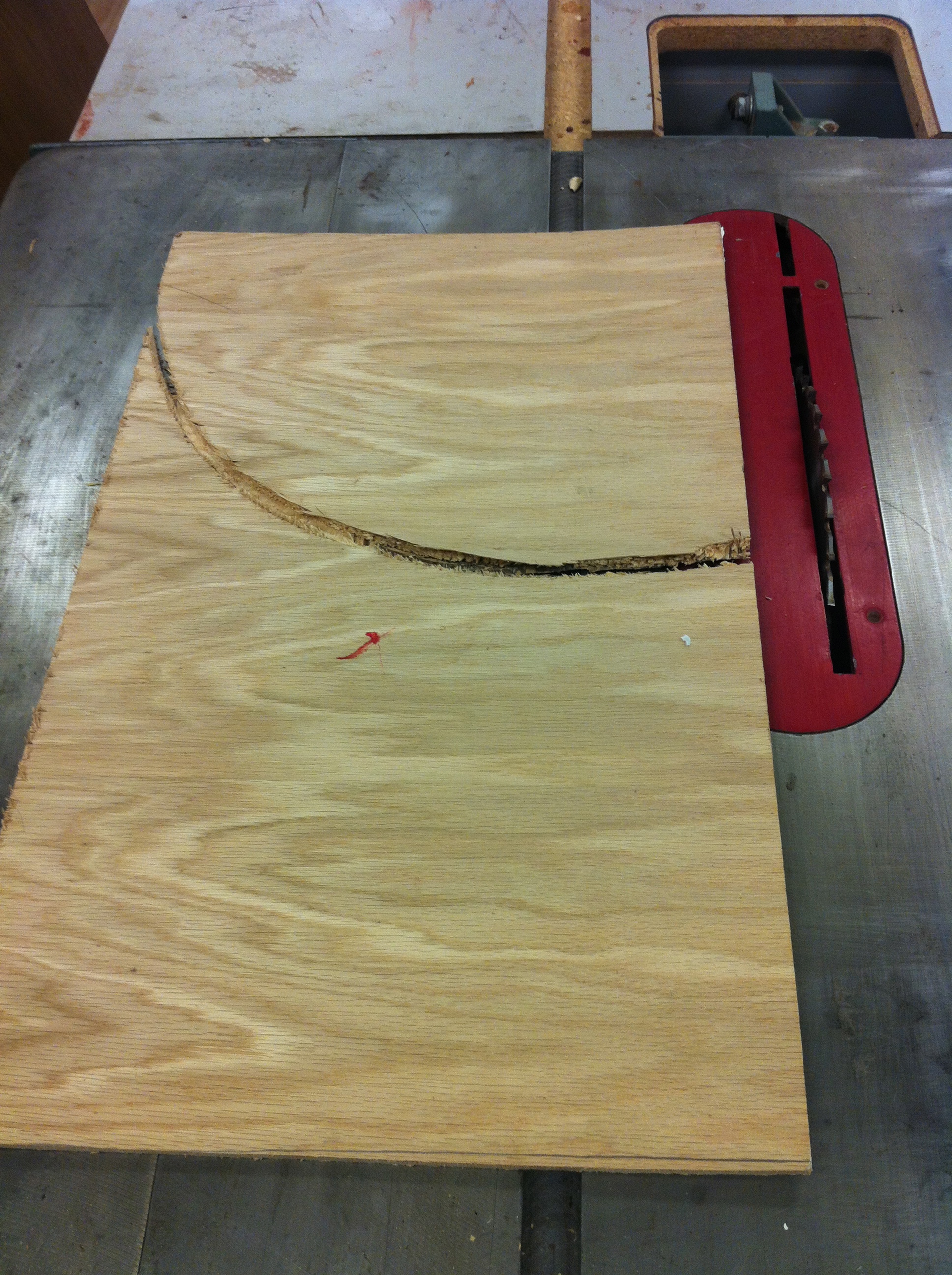
I went to the “Taming of the Skew” class at Highland last week and we spent three good hours with Hal Simmons, a professional turner, to try to solve some of the problems many people have trying to use a skew chisel.
We started out by learning how to sharpen the thing, first on a grinding wheel and then to a flat stone. As with almost any woodworking operation, having a sharp tool is a good thing. Hal asked each of us in turn what experience we had and what our issues were with the skew. After some discussion we moved to the fun part and we all got a good laugh. When Hal had a square piece of wood set up in the demonstration lathe, he turned the lathe up to very high speed and prepared to stick the skew into the wood. The whole class scattered like a flock of buzzards when a car comes along and Hal was standing there by himself. Apparently we all shared the same fear of the skew.
- Trying to Tame It
Once he calmed us all down and got us back to the demo lathe, he demonstrated how to use the skew to round off a work piece. He was standing there rounding that wood and not even looking at it, and we were all standing around with our mouths open and pleading with him to watch the work, because we were absolutely positive we knew what was going to happen and it was not going to be pretty.
After we learned the basic planing cut, we moved into cutting a groove and then to widening that groove into all those beautiful shapes found on candle holders and chair legs and balusters. The cuts are simple in theory when explained well, but as with most skills, take a while to develop the proper motions. It's the same answer you get in New York City when you ask someone how to get to Carnegie Hall. Practice, Practice, Practice!
At least I am not afraid of the tool anymore, and with a lot of practice I should be able to make some nice stuff. What a great class and it is offered every few months at the High. It runs from 5:30 to 8:30 in the evening and only costs $75. Go ahead, tame that skew!!
By the way if you are a Kindle owner, click over to Amazon and check "Blogs" for Kindle and look me up. You can subscribe and have this automatically downloaded into your Kindle. See You There!!
Subscribe to:
Posts (Atom)